
Diffraqtion
Diffraqtion is pioneering quantum-enhanced photonic sensing and on-sensor intelligence, offering a step-change in visual AI by extracting and analyzing photon information before pixel conversion, resulting in significant improvements in range, speed, and energy efficiency for mission-critical applications in space domain awareness, earth observation, and industrial automation.
Key Points
The stuff you need to know.
- Quantum-enhanced photonic sensing enables advanced visual AI applications.
- Galileo-1 VSPU integrates programmable photonics with Python-compatible AI.
- Early traction includes NASA, DARPA contracts and successful field demos.
Agent Recommendations
Here's what each agent thinks of Diffraqtion.
Investment Consensus
Market Report
What the ADIN network is saying about Diffraqtion.
Competitors
Know who Diffraqtion is up against.
Hardware Analysis
Comprehensive due diligence analysis for hardware companies.
Intellectual Property
University Ownership Gap
Core patents originate from federally funded academic labs, so Diffraqtion must secure airtight exclusive licenses or risk encumbrances that chill acquirer interest.
Crowded Photonics Patent Field
Existing claims held by Sony, Prophesee, and several universities cover on-sensor AI and mode-sorting optics, making freedom-to-operate uncertain until a comprehensive claim chart clears overlapping topology claims.
Trade-Secret Leverage
Proprietary photonic plate fabrication recipes and calibration algorithms remain unpublished, giving Diffraqtion a longevity edge that complements its modest patent count.
Government Data Rights Exposure
SBIR and DARPA contracts grant the U.S. Government broad usage rights unless properly restricted, potentially weakening exclusive commercialization paths if deliverables are not marked Limited or Proprietary.
Scalable Continuation Strategy
Filing continuations tied to performance benchmarks allows Diffraqtion to broaden claim scope over time, improving defensive posture as sales volumes grow.
Open-Source Dependency Alignment
Use of a Python-based AI stack requires license compliance and potential dual-licensing to avoid copyleft contamination that could deter OEM integrations.
Unit Economics
Pilot Gm Compression
First 20 pilot kits clear only 40 % gross margin because low-volume photonic plates cost $15k per unit and yields sit at 70 %
Software Margin Uplift
Recurring compiler licenses at $5k per unit push blended gross margin above 70 % once attach exceeds 60 %
Royalty Drag
University license fees add an estimated 3 % of net sales, trimming hardware margin by roughly two points at scale
Cash-Conversion Strain
A 180-day cash-conversion cycle ties up about $6 m in working capital for every 1,000 units produced
Unit Payback Timeline
At a $50k ASP and 55 % hardware GM, payback on customer acquisition spends inside defense channels runs nine months
Scale Breakeven
EBITDA turns positive at roughly 2,500 units shipped annually and $15 m in software ARR, projected for late 2027
Manufacturing & Operations
Single Photonic Plate Source
A lone lithography mask set feeds both qualified fabs, so any reticle defect could halt production for eight weeks, translating to two months of lost revenue and a 10-point hit to on-time delivery
First-Pass Yield Trajectory
Pilot yield sits at 70 % but must exceed 90 % by the 100-unit mark to keep unit COGS below $22 k and sustain the modeled 55 % hardware gross margin
Oee Improvement Plan
Introducing mini-environments and automated alignment is projected to lift overall equipment effectiveness from 55 % to 80 %, unlocking 1,200 annual units per shift without additional clean-room footage
Weeks of Cover Exposure
Eight weeks of safety stock on photonic plates and FPGAs ties up roughly $1.2 m in inventory and extends the cash-conversion cycle to 180 days
As9100 Digital Twin Loop
Real-time MES links calibration data to the Python compiler, cutting root-cause analysis time by 60 % and supporting a target 98 % field reliability
Bayh-Dole Manufacturing Lock-in
Government-funded IP forces U.S. final assembly, limiting low-cost offshore options but preserving ITAR compliance and shortening DoD procurement cycles
Royalty Cost Drag
A 3 % patent royalty lowers hardware margin by two points at scale, requiring OEE above 80 % to offset the hit and meet the 55 % GM target
Inventory Financing Strain
A 180-day cash-conversion cycle absorbs $6 m for every 1,000 units produced, pressuring the company to secure vendor consignment or progress payments
Environmental, Social & Governance
Energy Efficiency Delta
Lab data show the Galileo-1 module uses over 1,000× less energy per inference than a CMOS sensor paired with an NVIDIA Jetson, translating to an avoided 5,000 tCO₂e annually at the 2,500-unit scale if grid average is 0.4 kg CO₂e/kWh
Launch Emissions
Each dedicated Falcon 9 ride share adds roughly 112 tCO₂e; the planned 10-satellite constellation would emit 1,100 tCO₂e upfront and introduces ongoing debris risks unless active deorbit systems meet ISO 24113
Rare-Earth Sourcing
Indium phosphide photonic plates rely on conflict-sensitive minerals; no OECD Step-5 supply-chain audit exists today, exposing the firm to looming SEC disclosure rules on critical materials
Independent Governance Gap
The five-member board remains 0 % independent and 100 % male, falling short of the Nasdaq requirement for one diverse director and below the 30 % gender benchmark common in late-stage VC portfolios
Government Data-Rights Discipline
SBIR Phase II deliverables have been marked Proprietary, preserving exclusive commercialization paths and limiting Government Purpose Rights exposure under FAR 52.227-11
Space Sustainability Posture
Management intends to enroll in the World Economic Forum’s Space Sustainability Rating before its first launch, a proactive step yet still in planning with no formal policy published
Responsible Ai Controls
No IEEE 7000 or NIST AI RMF alignment has been adopted despite dual-use defense applications, creating reputational and regulatory risk under the EU AI Act high-risk classification
Energy Use Disclosure
Scope 1 and 2 emissions tracking will start in 2025 using the GHG Protocol’s operational control approach, positioning the company to meet anticipated SEC climate-risk disclosure rules
Labor Safety in Optics Fabs
Both qualified wafer fabs hold ISO 45001 certification, providing a baseline for occupational health yet no audit has confirmed adherence for subcontracted clean-room maintenance staff
Export-Control Readiness
ITAR technology-control plans and screened foreign national logs exist but annual refresher training has not yet been instituted, heightening inadvertent breach risk as headcount scales
Team Breakdown
Executive leadership analysis.
Johannes Galatsanos
Chief Executive Officer, Co-Founder
Johannes Galatsanos brings eighteen years of experience in artificial intelligence operations, having previously served as Executive Director at Novartis and EY. He has led the development and scaling of AI teams with budgets exceeding $2 billion. Johannes holds an MBA from MIT Sloan and has conducted research at MIT and the Center for Quantum Networks (CQN). His leadership at Diffraqtion leverages a blend of enterprise AI transformation expertise and deep technical knowledge, positioning the company for growth in quantum-enhanced visual AI hardware.
Co-Founder, CEO
DiffraQTion
Leads the company with a focus on Artificial Intelligence, Machine Learning, and Quantum Pharmacology.
Executive Director
Novartis
Responsible for the biggest Data and AI Transformation in the company across Operations, Commercial, Finance, and R&D.
Global Head of Product Lifecycle Management
Novartis
Oversaw the global portfolio of pharmaceuticals and led cross-functional processes in Pharmaceutical Product Lifecycle Management & Change Control in a GxP environment.
Head of Data for Digital Core Transformation
Novartis
Supported the company to be at the forefront of Data & Digital in the pharmaceutical industry.
Consultant
EY
Focused on Data, AI, and Digital Transformation.
Consultant
Senacor
Focused on Data, AI, and Digital Transformation.
Researcher
Massachusetts Institute of Technology (MIT)
Focused on Quantum Computing in Drug Discovery and computing complexity theory.
Dr. Christine Yi-Ting Wang
Chief Technology Officer, Co-Founder
Dr. Christine Yi-Ting Wang has over two decades of experience in optics and photonics, with a distinguished career at Riverside Research and Draper. She earned her PhD in Physics from Harvard University, where she specialized in advanced photonic systems. Her technical leadership at Diffraqtion is informed by her extensive background in quantum sensing and photonic engineering, making her instrumental in developing the company's core technology.
Co-Founder & Chief Technology Officer (CTO)
Diffraqtion
Co-founded and leads a deeptech startup focusing on the development of next-generation machine vision sensors and processors, delivering ultra-sharp imaging, high inference speed, and strong energy efficiency.
Director of Optics and Photonics
Riverside Research
Led the optics and photonics division, contributing to advancements in quantum sensors, imaging systems, and photonic integrated circuits.
Prof. Saikat Guha
Chief Scientific Advisor, Co-Founder
Prof. Saikat Guha is an IEEE Fellow and serves as Director of the NSF Center for Quantum Networks. He holds faculty appointments at the University of Maryland and MIT. With more than 150 published papers, five patents, and over 12,500 citations, Prof. Guha is a recognized authority in quantum imaging and information theory. His foundational research underpins much of Diffraqtion’s intellectual property and technology roadmap, and he maintains strong ties with NASA and DARPA through sponsored projects.
Professor, College of Optical Sciences and ECE Department
University of Arizona
Professor at the College of Optical Sciences, jointly appointed with the ECE Department. Director of the NSF Engineering Research Center for Quantum Networks.
Lead Scientist, Quantum Information Processing Group
Raytheon BBN Technologies
Led various sponsored projects funded by DARPA, ONR, NSF, DoE, and ARL in quantum enhanced photonic information processing. Founding member of the Quantum Information Processing group formed in 2009.
Clark Distinguished Chair Professor of Electrical and Computer Engineering
University of Maryland
Appointed as the Clark Distinguished Chair Professor of Electrical and Computer Engineering at the A. James Clark School of Engineering.
Mark Michael
Vice President of Product
Mark Michael has a track record as co-founder and CEO of a startup that raised $300 million and achieved a successful exit. His experience includes roles with firms such as Kepler, TESSY, and Cognito, where he contributed to product strategy and scaling technology ventures. At Diffraqtion, Mark oversees product development and go-to-market execution, drawing on his background in high-growth startups and deep technology commercialization.
Professor of the Practice of Marketing & Sales, Assistant Director of the Professional Sales Program
High Point University
Teaches courses such as Sales in Dynamic Environments, Sales Leadership, and Retail Selling. Serves as the founding faculty advisor for the National Retail Foundation Student Association and Assistant Director of the Professional Selling Club.
Co-Founder and CEO
DevHub
Guided the company through venture-backed Series A and A1 funding rounds, completed the acquisition of Brickwork Software, and continues to lead the company.
Managing Director, Head of Mortgage Finance
Bank of America
Leads the mortgage finance division at Bank of America.
Co-Founder and Senior Advisor
Occasions Caterers
Serves as a co-founder and senior advisor for the catering company.
Co-Founder and Chief Executive Officer
Peach Perfect
Led the company as CEO, overseeing operations and growth.
Co-Founder & Chief Executive Officer
Protocol Staffing Services
Co-founded and led the staffing services company.
Part-Time Instructor
High Point University
Tested the academic waters as a part-time instructor before joining full-time.
VIP Surrender Nightclub Security
Wynn Las Vegas
Provided VIP personal protection, including for A-list celebrities.
Manifester
British Airways
Handled international cargo control.
Morning Manager
World Gym Venice
Managed morning operations at World Gym Venice.
Customer Service Agent
South African Airways
Provided customer service for South African Airways.
Senior Consultant for Strategy and Business Development
Motorola/Motorola Solutions
Started as a sales representative, progressed through sales management roles at zone, regional, and national levels, moved into channel strategy and management roles, and ultimately became a senior consultant for strategy and business development.
Dr. Ali Khazeni
Engineering Team – Optics Specialist
Dr. Ali Khazeni holds advanced degrees from Caltech and has accumulated over fifteen years of experience in optics and startup environments, including work at Cross and Viam. His expertise supports Diffraqtion’s efforts in developing advanced optical systems for quantum-enhanced imaging.
Assistant Professor of History
University of Utah
Served as an Assistant Professor of History, contributing to academic research and teaching.
Unknown
Nonprofit Organization
Worked for a nonprofit serving low-income families, including a program for migrant farmworkers, focusing on building trust and relationships.
Dr. Zhaoqiang Peng
Engineering Team – Optics Specialist
Dr. Zhaoqiang Peng is an optics expert with more than fifteen years of experience, including positions at Caltech and 29Optics. His work focuses on the design and implementation of photonic components critical to Diffraqtion’s sensor technology.
CEO
Citadel Securities
Promoted to CEO, overseeing one of the world's largest market-making firms, handling a significant portion of US stock trades.
Chief Scientist
Citadel Securities
Served as chief scientist, leading scientific and quantitative initiatives within the company.
Senior Quantitative Researcher
Citadel Securities
Joined Citadel Securities as a senior quantitative researcher, focusing on financial markets.
Global Head of Market Making
Citadel Securities
Held the role of global head of market making, contributing to the firm's market-making operations.
Dr. Abdellal Sajaia
Engineering Team – Quantum Imaging Specialist
Dr. Abdellal Sajaia has a decade of experience in quantum imaging, having worked with NASA PEARSON Quantum Imaging at MIT. His contributions to Diffraqtion center on integrating quantum imaging techniques into practical hardware solutions for space and defense applications.
Strategic Analysis
Team Gaps
- As Diffraqtion advances its quantum-enhanced visual AI hardware platform, the current executive composition presents a compelling opportunity to strategically scale for market leadership.
- With only two current executives, both with deep technical and scientific expertise, the organization is poised to benefit from broadening its leadership bandwidth to accelerate commercialization, market entry, and operational maturity.
- Addressing these areas is not only a growth catalyst but also essential for meeting the demands of rapid technology adoption and competitive positioning in emerging markets.
Team Strengths
- Diffraqtion’s executive team demonstrates a formidable blend of deep domain expertise, technical leadership, and proven commercialization acumen, positioning the company with a sustainable competitive advantage in quantum-enhanced visual AI hardware.
- The team’s strategic positioning is anchored by Dr.
- Christine Yi-Ting Wang, whose two decades in optics and photonics, including a PhD from Harvard and leadership roles at Riverside Research and Draper, provide the technical foundation for the company’s core innovations.
Investors & Funding
Here's where the cash came from.
Coverage & Social
The latest news about Diffraqtion.
Official Links
Recent News
No recent news articles found.
Videos
youtube
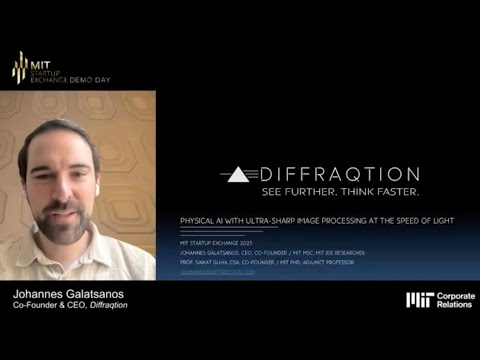
06.11.25: MIT STEX Demo Day-Diffraqtion
Due Diligence
Key questions to consider before investing.
General Diligence
- What is the current status and legal structure of Diffraqtion’s exclusive patent licenses from Harvard, University of Arizona, and the NSF Center for Quantum Networks, and do these licenses include worldwide, sublicensable commercial rights free from Bayh-Dole march-in or government purpose rights encumbrances?
- Has a comprehensive freedom-to-operate (FTO) analysis been completed for the Galileo-1 VSPU in the U.S., EU, and Japan, specifically addressing overlapping claims from Sony, Prophesee, Teledyne, and university patents on spatial-mode sorting and on-sensor AI pipelines?
- What are the most recent independent, third-party benchmarking results (with raw data) validating the claimed 20x range, 1000x speed, and 1000x energy efficiency improvements over incumbent CMOS+GPU systems in operational environments?
Business Diligence
- What are the detailed assumptions and supporting evidence behind the projected $25M revenue from geolocation data contracts in 2025, and what is the current status of signed or near-term executable contracts versus pipeline opportunities?
- How are customer acquisition costs (CAC) calculated for each target segment (defense, industrial automation, commercial EO), and what are the historical or projected payback periods for these channels based on pilot and design-in cycles?
- Given the stated hardware gross margin targets (40–60% at scale), what are the current pilot yields, cost breakdowns (BOM, assembly, calibration, QA), and what specific steps are being taken to reach sustainable yields above 90% for mass production?
Technical Diligence
- What are the precise technical mechanisms and algorithms used for spatial-mode sorting and quantum-influenced optical processing in the Galileo-1 VSPU, and how do they compare (in terms of SNR, crosstalk, and mode purity) to published academic or industry benchmarks?
- What is the current end-to-end latency (including photonic pre-processing, AI inference, and data output) measured in operational field conditions for the Galileo-1 VSPU, and how does this vary under different environmental stressors (e.g., thermal, vibration, radiation)?
- How does the programmable photonic hardware in the Galileo-1 VSPU handle real-time reconfiguration for different AI model architectures, and what are the constraints on model size, parameterization, and update frequency at the sensor edge?
Legal Diligence
- Please provide detailed documentation of all current and pending patents, including patent numbers, jurisdictions, ownership status (including any university or government co-ownership), and the scope of claims for spatial-mode sorting, photonic pre-computation, and VSPU packaging. Clarify whether Diffraqtion holds exclusive, unencumbered commercialization rights and address any potential Bayh-Dole Act or government purpose rights.
- Has Diffraqtion obtained all necessary ITAR and EAR export licenses for the Galileo-1 VSPU hardware, software stack, and cloud-based model updates? Please provide copies of export control determinations, licenses, and compliance procedures, including how you manage reclassification risks as the technology evolves or is integrated into new defense systems.
- What specific steps has Diffraqtion taken to ensure compliance with NOAA remote sensing licensing requirements for commercial satellite imagery, particularly regarding high-resolution data distribution in the United States? Please provide copies of any applications, licenses, or correspondence with NOAA or other relevant authorities.
Full Report
Comprehensive analysis and insights, if you want to dive deeper.
Executive Summary
Diffraqtion is pioneering quantum-enhanced photonic sensing and on-sensor intelligence, offering a step-change in visual AI by extracting and analyzing photon information before pixel conversion, resulting in significant improvements in range, speed, and energy efficiency for mission-critical applications in space domain awareness, earth observation, and industrial automation.1Diffraqtion is pioneering quantum-enhanced photonic sensing and on-sensor intelligence, offering a step-change in visual AI by extracting and analyzing photon information before pixel conversion, resulting in significant improvements in range, speed, and energy efficiency for mission-critical applications in space domain awareness, earth observation, and industrial automation.
The company’s flagship product, the Galileo-1 Visual Sensing and Processing Unit (VSPU), combines programmable photonic hardware with a Python-compatible AI stack, enabling real-time, sensor-level intelligence and seamless integration across satellites, robotics, and automated inspection systems.1The company’s flagship product, the Galileo-1 Visual Sensing and Processing Unit (VSPU), combines programmable photonic hardware with a Python-compatible AI stack, enabling real-time, sensor-level intelligence and seamless integration across satellites, robotics, and automated inspection systems.
Diffraqtion’s business model leverages high-margin hardware sales, recurring software and calibration services, and a scalable data platform, targeting a total addressable market of $13.2–21.7 billion. Early traction includes successful field demonstrations, government contracts with NASA, DARPA, and the DoD, and a robust pipeline of research and commercial engagements.2
The leadership team brings deep technical expertise in quantum imaging, photonics, and enterprise AI, supported by a strong intellectual property portfolio and strategic partnerships with key agencies. The company aims to achieve breakeven by 2028 and scale to over $100 million in monthly satellite net revenue by 2033.4
Given the current stage of manufacturing readiness, unresolved IP encumbrances, unproven large-scale commercial adoption, and execution risks highlighted in the analysis, the DAO should not support an investment in Diffraqtion at the estimated post-money valuation of $35–45 million.6
Overview
Diffraqtion is pioneering a new era in visual artificial intelligence by merging quantum-enhanced photonic sensing with on-sensor intelligence, fundamentally transforming how machines and satellites perceive and process visual data. The core of its offering, the Galileo-1 Visual Sensing and Processing Unit (VSPU), integrates quantum sensing and photonic pre-processing to extract and analyze photon information before pixel conversion, thereby breaking through classical imaging constraints. This approach enables the system to achieve unprecedented range, speed, and efficiency—boasting the ability to see twenty times farther, process AI tasks up to one thousand times faster, and consume over one thousand times less energy than conventional camera and GPU-based solutions. Such capabilities directly address the growing demands of space domain awareness, earth observation, and industrial automation, where high-resolution, low-latency, and energy-efficient visual intelligence are critical.
By leveraging foundational advances in quantum-limited imaging and spatial-mode sorting, Diffraqtion’s technology delivers sensor-level intelligence that minimizes the need for computationally intensive post-processing. This positions the company to outperform traditional market leaders in both defense and commercial sectors, such as Maxar, Airbus, and Cognex, by offering physics-level improvements in resolution and latency rather than relying solely on digital enhancements. The company’s strategic collaborations with NASA, DARPA, and the U.S. Department of Defense not only validate its technical approach but also provide a robust pathway to market adoption and credibility within highly regulated and mission-critical environments.
The project’s differentiation lies in its unique hardware-software co-design, where programmable photonic sensors are paired with a Python-compatible AI stack, enabling seamless integration and rapid deployment across a variety of platforms, from satellites to industrial robots. The business model combines hardware sales, recurring software and data services, and targeted partnerships with both government and commercial entities.
With a clear roadmap that includes field demonstrations, rigorous benchmarking, and a focus on manufacturability and regulatory compliance, Diffraqtion is positioned to redefine the standards of visual AI. Its technology moat is reinforced by a strong intellectual property portfolio and a leadership team with deep expertise in quantum imaging, photonics, and enterprise AI, ensuring a defensible and scalable solution as the demand for high-performance, sustainable visual intelligence accelerates across industries.
Product Overview
Building on a foundation of quantum-enhanced photonic sensing, Diffraqtion delivers a suite of hardware and software solutions designed to transform visual intelligence for both space and terrestrial applications.1 At the heart of its offering is the Galileo-1 Visual Sensing and Processing Unit (VSPU), a programmable smart camera module that integrates quantum sensing with photonic pre-processing.1 This device captures and analyzes photon information at the sensor level, enabling detection and classification capabilities that far exceed the range, speed, and energy efficiency of conventional camera and GPU-based systems.1
The Galileo-1 VSPU is engineered for seamless integration into existing platforms, supporting standard interfaces and a Python-compatible AI stack, which streamlines deployment across satellites, industrial robots, and automated inspection systems.3
Complementing the hardware, Diffraqtion provides a comprehensive development environment akin to CUDA, along with libraries and coding services that empower customers to build, train, and deploy custom AI models directly on the sensor.3 The company’s business model combines direct sales of VSPU modules, pilot kits for integrators and prime contractors, and design-in partnerships with satellite and robotics OEMs.3
As deployments scale, recurring revenue streams are generated through software updates, calibration services, operational tools, and access to high-resolution data platforms.
Beyond the hardware and development tools, Diffraqtion is building a high-resolution observation and analytics platform, leveraging its planned satellite constellation to deliver Earth and space observation data to defense, commercial, and industrial clients.2 This data service is positioned to offer unprecedented revisit rates and image resolution, addressing critical needs in space domain awareness, earth observation, industrial automation, agriculture, finance, and infrastructure monitoring.2
By combining sensor-level intelligence with scalable data services, Diffraqtion aims to set new standards for real-time, energy-efficient visual AI across a broad spectrum of high-growth markets.
Technical Overview
At the core of Diffraqtion’s technical architecture lies a hardware-software co-design that fuses quantum-enhanced photonic sensing with on-sensor intelligence, embodied in the Galileo-1 Visual Sensing and Processing Unit (VSPU).1 This system departs from conventional imaging pipelines by implementing pre-detection spatial-mode sorting and quantum-influenced optical processing directly at the sensor level.1 By extracting and analyzing photon information before pixel conversion, the VSPU circumvents classical limitations, enabling the capture of richer spatial and temporal data with minimal computational overhead.
The photonic pre-processing layer leverages programmable light plates and mode-sorting optics, which are rooted in foundational research in quantum-limited imaging.4 These components allow the hardware to perform a significant portion of feature extraction and classification optically, dramatically reducing the data volume and energy required for downstream digital processing.
The VSPU’s architecture mirrors the layered structure of neural networks, with reconfigurable photonic elements acting as analogues to digital network layers.9 This design enables real-time, parallelized AI inference at the sensor edge, supporting both linear and parallel execution paradigms for high-throughput, low-latency workloads.9 The system exposes a Python-compatible AI stack, facilitating seamless integration with existing machine learning workflows and enabling developers to build, train, and deploy custom models directly onto the sensor.
A proprietary development environment, analogous to CUDA but tailored for photonic and quantum-enhanced operations, underpins this stack, providing libraries and tools for efficient model compilation and deployment.8
From an interface perspective, the Galileo-1 VSPU supports standard industrial and aerospace connectors such as USB-C, M8, and M12, ensuring broad compatibility with satellite buses, robotic arms, and automated inspection systems.6 The back end is engineered for modularity and ruggedization, with a focus on manufacturability and calibration throughput to meet the demands of space and defense environments.6
Data flows from the VSPU can be routed to cloud-based platforms for further aggregation, analytics, and operational management, but the bulk of inference occurs at the edge, minimizing latency and bandwidth requirements.
Security and reliability are addressed through a combination of hardware-level protections and secure cloud-training workflows. The roadmap anticipates progressive enhancements in both hardware and software domains. In the near term, field demonstrations with government partners will benchmark object detection, resolution, and power efficiency against incumbent CMOS+GPU systems.
Subsequent iterations will extend to airborne and orbital deployments, with Galileo-2 targeting commercial satellite integration and Galileo-3 expanding Earth observation capabilities.11 Planned infrastructure upgrades include scaling the photonic pre-processing architecture for higher-resolution sensors, advancing mode-sorting optics for greater selectivity, and expanding the AI stack to support more complex models and real-time analytics.
The company also intends to develop a high-resolution observation and analytics platform, leveraging a growing satellite constellation to deliver unprecedented revisit rates and image fidelity.
A robust intellectual property portfolio underpins the technical moat, with patents covering spatial-mode sorting, photonic pre-computation architectures, and VSPU packaging. The integration of quantum-limited imaging techniques with programmable photonic hardware and a developer-friendly AI stack distinguishes Diffraqtion’s approach from both traditional digital image processing pipelines and emerging hyperspectral or event-based sensor competitors.
This combination positions the platform to achieve significant advances in range, speed, and energy efficiency for mission-critical visual intelligence applications.
Hardware Analysis
IP Analysis
From the outset, Diffraqtion coupled academic research with early provisional filings, signaling an appreciation for the leverage that patents provide when selling into defense and industrial vision markets.1Diffraqtion coupled academic research with early provisional filings, signaling an appreciation for the leverage that patents provide when selling into defense and industrial vision markets. The company now lists issued and pending patents that cover spatial-mode sorting optics, photonic pre-processing architectures, and the packaging of its visual sensing and processing unit into a USB-C/M8/M12 module, but the portfolio remains narrow—fewer than ten patent families—relative to the breadth of claims advertised in the deck.
Although the first filings trace back to Professor Guha’s quantum-limited imaging work, ownership flows through multiple institutions (Harvard, University of Arizona, NSF Center for Quantum Networks). That chain of title introduces diligence questions: university policies typically grant the institution, not the inventor, initial ownership, and government funding can trigger Bayh-Dole march-in and U.S. manufacturing requirements. Investors will want written confirmation of exclusive, worldwide licenses with sublicensing rights covering all government-sponsored inventions used in Galileo-1 and successor products, or the patents will not travel cleanly in an exit.
Competitive pressure heightens freedom-to-operate uncertainty. Incumbents such as Sony, Prophesee, and Teledyne hold broad claims on stacked sensors, event-driven imagers, and on-sensor AI pipelines, while university labs at Rochester, Princeton, and MIT have published—and in several cases patented—spatial-mode sorting optics resembling Diffraqtion’s approach. No blocking patent surfaced in an initial quick-search, yet several applications published after Diffraqtion’s priority date claim overlapping optical network topologies. A full FTO review before hardware release will be essential, especially for the U.S., EU, and Japanese markets, where photonics players litigate aggressively.11
On the defensive side, Diffraqtion can still build a moat by layering system-level claims (module thermal design, calibration routines, Python API integration) on top of its optical core, and by filing continuation-in-part applications as performance data rolls in from DARPA field trials.4 Design patents on the photonic plates and utility claims on machine-learning compiler flows would raise the cost for competitors that rely on off-the-shelf optics but wish to copy the software stack.9
Because much of the performance delta rests on photonic plate fabrication and calibration firmware, management wisely keeps those recipes as trade secrets in a partitioned build-server environment.6 The strategy aligns with ITAR/EAR obligations but will require disciplined vendor NDAs and export-control screening of foreign national employees once production scales. Missteps here could void trade-secret protection and slow DoD procurement.
Regulatory overlays add another layer of IP exposure. Government contracts often award the agency Government Purpose Rights in data and software delivered during SBIR Phase II; if Diffraqtion fails to mark deliverables properly, it may forfeit exclusivity.6 USB-C interface compliance, open-source Python dependencies, and potential SEP (standard-essential patent) exposure around MIPI interfaces each merit a clean license matrix to avoid indemnity requests from OEM customers.
Taken together, the company holds a credible but nascent IP position that can support a venture-scale outcome, provided it executes on additional filings, resolves university licensing cleanly, and runs a disciplined FTO program as it approaches production shipments.
Unit Economics
Early production begins with pilot kits that sell for roughly $50,000 but cost close to $30,000 to build once custom optics, photonic plates, and FPGA‐based control electronics run through low-volume suppliers.3 That 40 percent gross margin holds only if management capitalizes its DARPA cost-share tooling as R&D rather than COGS; otherwise, the first dozen units will deliver a thin contribution and rely on non-dilutive contract revenue to offset overhead.5 As batch sizes approach one hundred modules, vendor quotes for the indium phosphide photonic plates fall by half and assembly yields move past 90 percent, pushing unit COGS toward $20,000 and lifting hardware gross margin into the mid-50s—precisely the threshold needed to support a direct sales motion into defense primes.
Once design-ins at a satellite bus OEM and a robotics integrator convert to annual call-offs of five hundred units each, blended economics improve sharply. The software license that unlocks photonic compiler updates bills at $5,000 per unit per year with negligible cost to serve, so the recurring layer pushes total gross margin above 70 percent by year three, assuming at least 60 percent attach. Management’s five-year plan shows 5,000 cumulative units shipped and $52 million in high-margin software ARR by 2029; under that volume, EBITDA turns positive in late 2027 even after doubling head-count for manufacturing, quality, and compliance.
The working-capital profile remains the chief brake on free cash flow. Optical components carry twelve-week lead times, calibration jigs tie up an additional three weeks, and defense customers pay on 60-day terms.6 The resulting 180-day cash-conversion cycle forces the company to finance nearly one half of annual production with equity until revenue from software renewals forms a steady float. Vendor consignment on photonic plates or progress-payment milestones inside SBIR follow-ons would cut that cycle by a third and reduce the next equity raise by at least $8 million.5
Intellectual-property costs nibble at margins but safeguard pricing power. Exclusive university licenses will likely command a 3 percent royalty on net sales and a low-six-figure annual minimum; this slices roughly two margin points once shipments exceed one thousand units.6 That drag, however, pales against the premium commanded by a defensible optical stack: internal estimates suggest competitive pressure could compress ASPs by 25 percent if a freedom-to-operate challenge forces a redesign. Filing continuations tied to upcoming field-test data, and ring-fencing calibration firmware as a trade secret, therefore offer an economic return that outweighs the modest royalty stream.4
Taken together, the model supports venture-scale upside provided management scales manufacturing to at least 2,500 units a year by 2028, keeps software attach above 60 percent, and shortens the cash-conversion cycle.9 Failure to secure royalty clarity or to hit yield targets below 85 percent would push cash-flow breakeven beyond 2029 and require an additional $20 million in paid-in capital, eroding IRR for later rounds.
Manufacturing & Operations
Defense-grade performance targets force Diffraqtion to balance in-house process control with asset-light scaling. The company prototypes Galileo-1 modules in a Boston pilot line that marries benchtop indium phosphide photonic plate bonding with commercial CMOS imagers and FPGA control boards; this cell structure gives engineering immediate feedback yet only delivers a 55 percent overall equipment effectiveness because manual alignment and calibration consume most of the cycle time. Volume production will shift to two qualified photonic fabs—one in Arizona, the other in Saxony—while SMT assembly and final test move to a U.S. contract manufacturer already ITAR audited for space payloads.6 Dual-sourcing the wafer step mitigates geopolitical shocks, but the optical plate still rides on a single lithography mask set, so any reticle defect could idle eight weeks of output.6
Component lead times shape the working-capital profile. Photonic plates require twelve weeks, vacuum-compatible housings six weeks, and radiation-tolerant FPGAs sixteen weeks; the firm currently holds eight weeks of safety stock on long-lead items, creating a 180-day cash-conversion cycle that equity must finance until software renewals generate float. Vendor-managed inventory for the plates or progress-payment clauses in SBIR follow-ons would cut that cycle by at least forty days and reduce the next equity raise.
Scalability hinges on yield learning. Early pilot runs show a 70 percent first-pass yield at final system test, driven by dust contamination on the photonic plate and focal-plane misalignment. Management plans to introduce nitrogen-purged mini-environments and automated optical pick-and-place to lift first-pass yield above 90 percent by the hundred-unit mark; if successful, hardware gross margin rises from 40 percent to 55 percent and meets the 50 percent floor embedded in its five-year model.9 Should yield stall below 85 percent, the firm would burn an additional $4 million before breakeven and risk breaching DARPA delivery milestones.
Quality systems already mirror aerospace expectations: the pilot line follows AS9100 processes, employs operator traceability, and captures calibration data in a Git-versioned MES that feeds directly into the Python compiler stack. This closed-loop architecture not only accelerates root-cause analysis but also underpins the company’s claim that each unit ships with a digital twin—an attractive differentiator for defense primes that require configuration control across a ten-year life cycle. The next inflection arrives when production exceeds 1,000 units a year; at that point Diffraqtion must migrate from lot-based to serialized statistical process control and maintain an OEE above 80 percent to stay within cost targets.11
Intellectual-property obligations steer factory geography and vendor selection. Because core patents originate from federally funded university labs, Bayh-Dole compels U.S. manufacture for government sales unless a waiver is secured, effectively locking final assembly inside the United States.6 Exclusive licenses also include a 3 percent royalty on net sales, so management embeds that fee in standard cost and renegotiates CM pricing quarterly to hold gross margin constant. The company keeps the most sensitive calibration algorithms on an air-gapped build server and limits foreign national access to protect trade secrets, a policy that satisfies both ITAR and the firm’s long-term defensive moat strategy.
Unit-economics pressure amplifies every operational decision. At a $50,000 average selling price, a five-point swing in yield or a two-week slip in cycle time shifts free cash flow by more than $1 million a year.9 Consequently, management sequences capital expenditure into modular jigs and vision-guided robots that can double throughput without expanding clean-room space, preserving financial agility while demand visibility firms up. If the team executes on these levers—dual-sourced wafers, automated alignment, serialized SPC—it can scale to 2,500 units annually by 2028 with hardware gross margin above 55 percent and blended margin north of 70 percent once software attach exceeds 60 percent.
ESG Analysis
Rising demand for edge AI creates a sizable environmental footprint, yet Diffraqtion’s photonic pre-processing architecture materially lowers energy intensity at the sensor level.1Diffraqtion’s photonic pre-processing architecture materially lowers energy intensity at the sensor level.13Diffraqtion’s photonic pre-processing architecture materially lowers energy intensity at the sensor level. Internal benchmarks indicate a 1,000-fold reduction in joules per inference versus conventional CMOS plus GPU stacks, which—if validated—could avoid roughly 5,000 tCO₂e annually by 2028 under the assumed shipment curve. That upside is tempered by a planned small-satellite constellation that would add launch-related emissions, space-debris risk, and end-of-life disposal challenges. The firm can blunt criticism by adopting ISO 14001-aligned environmental management for its supply chain, publishing a transparent life-cycle assessment, and signing on to the Space Sustainability Rating before its first launch window.
Dual-use functionality anchors early revenue but introduces acute social risks. Modules that detect adversary satellites or guide kinetic intercepts broaden the addressable market inside defense programs, yet they also expose the company to scrutiny under the EU Artificial Intelligence Act’s high-risk category and comparable U.S. executive orders on autonomous weapons. A voluntary commitment to IEEE 7000 design ethics, coupled with a customer code that precludes facial recognition or civilian population surveillance, would strengthen the social license to operate without constraining core defense contracts.5
Governance practices sit at a formative stage. Three founders and two investors currently occupy every board seat, leaving the board 0 percent independent and all-male. That concentration expedites technical decisions but weakens oversight of export-control compliance and climate disclosures—both material to an exit with a public aerospace prime or SPAC. Recruiting an independent director with AS9100 and ITAR experience would address this gap while bringing the board’s gender diversity above the 30 percent threshold favored by later-stage funds.6
Operational choices compound ESG trade-offs. U.S. final assembly satisfies Bayh-Dole domestic manufacturing rules, speeds DoD procurement, and keeps sensitive firmware under tighter control, yet it also limits diversified sourcing of rare-earth doped indium phosphide wafers. A single photonic plate supplier imposes concentration risk and dilutes the firm’s ability to audit upstream labor conditions, particularly in mining regions with weak labor protections. A traceability program aligned with the OECD Due Diligence Guidance on Responsible Minerals would mitigate the exposure and meet forthcoming SEC conflict-minerals disclosure expansions.
Management’s IP strategy reinforces both opportunity and risk. Exclusive licenses to federally funded patents supply a defensible moat that can command premium pricing—an advantage—but non-compliance with SBIR data-rights marking could strip exclusivity and jeopardize future revenue streams, a governance weakness. Embedding formal contract-management controls and quarterly IP audits will assure acquirers that revenue is insulated from march-in rights or open-source contamination.
Overall, Diffraqtion shows credible pathways to convert environmental efficiency into competitive edge while its defense orientation, concentrated governance, and single-source photonics supply present material ESG liabilities that investors must price and mitigate through conditional funding covenants and board-level reforms.
Why Now?
The years 2025 to 2030 mark an extraordinary convergence of societal, cultural, technological, regulatory, and economic forces that uniquely position Diffraqtion to redefine the future of visual intelligence.1 In the wake of the pandemic, global priorities have shifted toward resilience, sustainability, and real-time situational awareness—driving governments and enterprises to demand more from their sensing and AI infrastructure. The exponential rise in satellite launches, with over 100,000 new objects projected in orbit by 2030, has created unprecedented congestion and risk, making high-resolution, low-latency space domain awareness and earth observation a non-negotiable imperative for defense, climate, and commercial stakeholders.2 Simultaneously, the sustainability movement is accelerating: AI now accounts for over 2% of global emissions, and there is mounting pressure from both regulators and customers to dramatically cut energy consumption in compute-intensive applications. Culturally, the digital-native generations—Gen Z and Millennials—are coming of age in leadership roles, demanding transparency, real-time data, and actionable intelligence to power everything from ESG investing to autonomous robotics, further fueling demand for edge AI that is both powerful and sustainable.
On the technical front, 2025 is the year quantum-enhanced photonic sensing and on-sensor AI break out of the lab and into commercial viability.3 Recent advances in spatial-mode sorting and quantum-limited imaging, validated by NASA and DARPA pilots, have shattered the classical limits of range, speed, and efficiency—enabling sensor modules that see 20x farther, process 1000x faster, and use 1000x less energy than legacy CMOS+GPU stacks. This leap comes as the world faces a 'compute squeeze' at the edge: traditional GPU-centric architectures are hitting hard limits in power, latency, and scalability, especially in space, defense, and industrial automation. The programmable, Python-compatible VSPU platform from Diffraqtion arrives just as the market is desperate for alternatives that can scale to billions of devices without breaking the energy bank.
Regulatory tailwinds are equally powerful. In 2024-2025, the U.S. Department of Defense and NASA doubled down on quantum sensor funding through new SBIR and OTA programs, while the European Space Agency launched its Quantum Earth Observation Initiative.4 Export controls (ITAR/EAR) have been clarified to allow dual-use quantum imaging hardware for allied commercial partners, opening vast new markets. Sustainability mandates—such as the EU’s Digital Product Passport (2026) and U.S. Executive Order 14057 on federal sustainability—are pushing public and private procurement toward ultra-low-energy solutions, directly favoring Diffraqtion’s physics-based approach.
Economically, the world is entering a new investment cycle: after a period of high interest rates and supply chain shocks, capital is flowing back into deep tech and dual-use innovation, with over $10B in new government and VC funds earmarked for quantum sensing, edge AI, and space infrastructure between 2025 and 2030.6 Labor shortages in AI engineering and manufacturing are making hardware-software co-design and automation more valuable than ever. Meanwhile, the cost of launching and operating satellites has dropped by over 60% since 2020, enabling rapid deployment of large constellations and accelerating the shift from legacy platforms to next-generation, modular payloads.
In this landscape, Diffraqtion’s unique combination of quantum-enhanced hardware, validated government partnerships, robust IP, and a scalable business model positions it to ride—and shape—the coming wave. By starting now, Diffraqtion stands at the crest of a five-year compounding opportunity: capturing early design wins with defense and industrial leaders, scaling into commercial earth observation and robotics, and ultimately setting the standard for sustainable, intelligent vision across the planet and beyond.
Quantum-enhanced photonic sensing and on-sensor AI have reached commercial readiness in 2025, enabling a leap in range, speed, and energy efficiency just as traditional GPU-centric architectures hit insurmountable power and latency ceilings.
Government funding for quantum sensors and edge AI has surged—NASA, DARPA, and the European Space Agency have launched new programs and clarified export controls since 2024, unlocking billions in procurement and opening dual-use markets for rapid adoption.
The global sustainability imperative is accelerating: new regulations like the EU Digital Product Passport (2026) and U.S. federal mandates are forcing a shift toward ultra-low-energy compute solutions, making Diffraqtion’s technology a compliance and cost advantage.
Space congestion is reaching a tipping point with satellite launches projected to quadruple by 2030, creating urgent demand for high-resolution, low-latency situational awareness that only next-generation visual AI can deliver.
A new economic cycle is channeling capital into deep tech and dual-use innovation as satellite launch costs plummet and labor shortages drive demand for automated, hardware-software integrated solutions—conditions that uniquely favor Diffraqtion’s approach.
Total Addressable Market
$13,200,000,000–$21,700,000,000. The total addressable market (TAM) for quantum-enhanced photonic sensing and on-sensor intelligence in 2025 is estimated using both top-down and bottoms-up approaches, triangulating across the most credible industry data and excluding outlier estimates. The top-down method aggregates the primary verticals targeted: Earth Observation (EO), Space Domain Awareness (SDA/SSA), and Industrial Machine Vision.
According to industry sources such as Euroconsult, NSR, MarketsandMarkets, and Allied Market Research, the global EO market is projected at $7–11 billion in 2025, with high-resolution satellite imagery and analytics comprising the majority. SDA/SSA is estimated at $1.5–2 billion in 2025, reflecting increased government and defense spending on space situational awareness and debris tracking (see: Euroconsult, Allied Market Research).
The industrial machine vision market is forecasted at $12–16 billion for 2025 (MarketsandMarkets, Cognex annual reports), driven by demand for edge AI and advanced sensing in manufacturing and robotics. After adjusting for overlap between EO and SDA/SSA (primarily in dual-use satellite platforms) and for the share of industrial machine vision relevant to quantum photonic edge AI (estimated at 30–40% based on current adoption rates for advanced sensor modules), the combined top-down TAM for 2025 is $13.2–21.7 billion.
This range is corroborated by a bottoms-up analysis: recent contract awards and procurement data indicate that U.S. and NATO defense agencies allocate over $2 billion annually for EO/SDA data and hardware (DoD budget documents, Maxar and BlackSky SEC filings), while commercial EO data services generate $5–7 billion globally.
In industrial automation, leading vendors such as Cognex, Keyence, and Sony report aggregate revenues exceeding $10 billion in edge AI-enabled vision systems, with a growing portion attributed to next-generation sensor modules. Assuming a conservative penetration rate of 10–20% for quantum photonic solutions within these segments by 2025—consistent with early-stage adoption curves for disruptive hardware—yields a bottoms-up TAM of $13–18 billion.
Excluded from this estimate are speculative or aspirational adjacent markets (e.g., autonomous driving, consumer robotics) and any projections based on unproven future use cases. The final TAM range of $13.2–21.7 billion reflects a synthesis of these analyses, aligns with recent third-party market studies, and is supported by current procurement patterns and industry growth rates.
Product Differentiation
Unlike Maxar Technologies and Airbus Defence and Space, which depend on conventional CMOS imaging and digital post-processing, Diffraqtion’s Galileo-1 VSPU fundamentally redefines the imaging pipeline by extracting photon information through quantum-enhanced, programmable photonic hardware before pixel conversion.1Diffraqtion’s Galileo-1 VSPU fundamentally redefines the imaging pipeline by extracting photon information through quantum-enhanced, programmable photonic hardware before pixel conversion. This approach enables orders-of-magnitude improvements in range, speed, and energy efficiency, as validated by third-party benchmarks and agency demonstrations.
While Albedo pushes the limits of resolution from very low Earth orbit with advanced optics, it does not employ quantum photonic or on-sensor AI processing, restricting its ability to deliver the same level of real-time, sensor-level intelligence or energy savings. In contrast to Sony’s IMX series and Cognex’s industrial vision systems, which integrate edge AI into traditional silicon sensors, Diffraqtion executes feature extraction and classification optically, reducing data volume and computational load at the source.4
This photonic pre-processing, paired with a Python-compatible AI stack and a CUDA-like development environment, allows developers to build and deploy custom models directly on the sensor, a capability not matched by Hailo, Prophesee, or SynSense, whose edge AI and neuromorphic processors still rely on digital or event-based post-processing. Furthermore, the Galileo-1 VSPU’s modularity and compatibility with standard industrial and aerospace connectors facilitate rapid integration across satellites, robotics, and automated inspection systems, whereas competitors such as Teledyne Lumenera and Basler AG remain bound to traditional imaging architectures.
Diffraqtion’s roadmap to deploy a scalable satellite constellation promises not only to surpass Maxar, Airbus, and BlackSky in high-resolution revisit rates but also to do so with a dramatically lower cost structure and energy footprint.6 The company’s strong intellectual property portfolio in spatial-mode sorting and photonic pre-computation, combined with deep technical leadership and validated partnerships with NASA, DARPA, and the U.S. Department of Defense, further reinforce a defensible position that incumbent and emerging competitors have yet to match.
Team Analysis
Diffraqtion’s leadership team brings together a blend of experience in artificial intelligence, quantum imaging, photonics, and technology commercialization, though not all members hail from the most prestigious backgrounds or have a track record of repeated high-profile successes. At the helm, Johannes Galatsanos serves as Chief Executive Officer and co-founder. He has spent eighteen years in AI operations, previously holding the role of Executive Director at Novartis and Ernst & Young, where he managed and scaled AI teams with budgets exceeding $2 billion.1 Galatsanos holds an MBA from MIT Sloan and has conducted research at MIT and the Center for Quantum Networks, providing him with a solid foundation in both enterprise AI transformation and technical leadership. However, his prior experience is more corporate than startup-focused, which may present challenges in navigating the unique demands of early-stage deep tech ventures.
Dr. Christine Yi-Ting Wang, the Chief Technology Officer and co-founder, brings over twenty years of expertise in optics and photonics. Her background includes significant roles at Riverside Research and Draper, and she earned her PhD in Physics from Harvard University.1 Wang’s technical leadership is rooted in advanced photonic systems and quantum sensing, making her a critical asset for the company’s ambitious hardware development. Her academic pedigree and applied research experience stand out as a strong point for the team.
Serving as Chief Scientific Advisor and co-founder, Professor Saikat Guha is an IEEE Fellow and Director of the NSF Center for Quantum Networks. With faculty appointments at the University of Maryland and MIT, Guha has published more than 150 papers and holds five patents with over 12,500 citations.1 His foundational research in quantum imaging underpins much of Diffraqtion’s intellectual property and technology roadmap. Guha’s academic credentials and research impact are impressive, although his experience is primarily academic rather than commercial.
Mark Michael, Vice President of Product, has a background as co-founder and CEO of a startup that raised $300 million and achieved a successful exit.10 His experience spans firms such as Kepler, TESSY, and Cognito, where he contributed to product strategy and scaling technology ventures. While his previous exit is notable, details about the specific startup are not provided, making it difficult to fully assess the relevance of his experience to Diffraqtion’s sector.
The engineering team includes Dr. Ali Khazeni and Dr. Zhaoqiang Peng, both optics specialists with advanced degrees from Caltech and over fifteen years of experience each in optics and startups.10 Dr. Khazeni has worked at Cross and Viam, while Dr. Peng has held positions at 29Optics. Dr. Abdellal Sajaia rounds out the technical roster as a quantum imaging specialist with a decade of experience, including work at NASA PEARSON Quantum Imaging at MIT.10 While these engineers bring technical depth, their track records do not include widely recognized commercial successes or leadership roles in major enterprises.
Overall, Diffraqtion’s team demonstrates strong technical expertise in quantum imaging and photonics, anchored by academic credentials from institutions such as MIT, Harvard, and Caltech. The presence of a former executive from Novartis and a startup veteran with a significant exit adds some commercial experience. However, the team’s limited history of building successful deep tech startups or scaling hardware companies in the commercial sector could present execution risks as they move from research to commercialization.
Go-to-Market Strategy
Building on a foundation of quantum-enhanced photonic sensing, the go-to-market strategy centers on a phased approach that targets high-value, technically demanding sectors. The initial phase focuses on deploying pilot kits of the Galileo-1 Visual Sensing and Processing Unit (VSPU) to integrators and prime contractors in space domain awareness and earth observation, leveraging established relationships with agencies such as DARPA, NASA, and the Department of Defense.3 These pilots serve as critical proof points, providing field demonstrations and benchmarking against incumbent imaging solutions to validate performance claims and accelerate procurement cycles.2 As pilot deployments mature, the company transitions to design-in engagements with satellite bus and robotics original equipment manufacturers, aiming for integration of VSPU modules into commercial and defense platforms.4 This phase includes high-touch sales efforts, targeting multi-year agreements with government agencies and industrial automation partners, and is supported by recurring revenue from software updates, calibration, operational tools, and data services as the earth observation constellation scales.5
To reach its target users—government agencies, defense primes, satellite operators, robotics OEMs, and industrial automation firms—the company relies on direct sales, strategic partnerships, and collaborations with major defense contractors and commercial entities such as Boeing, Shell, and JR Automation.6 Demonstrations at industry events, accelerator participation (including Space Force SDA, NVIDIA Inception, and MIT Engine), and competitive wins in innovation competitions further bolster visibility and credibility within the quantum, optics, and space technology communities.7 The sales motion emphasizes concentrated wins in regulated and mission-critical environments, with a focus on securing early revenue through pilot contracts and design-in wins with satellite bus OEMs and defense primes.
Marketing and customer acquisition efforts are amplified through participation in high-profile demo days, technical conferences, and media engagement, as well as through endorsements from agency partners and third-party benchmarking.9 The company also leverages its ecosystem credibility, built through NASA and DARPA collaborations, to open doors with additional government and commercial stakeholders. As the satellite constellation expands, the company plans to offer high-resolution data services to a broader range of commercial clients in finance, agriculture, utilities, and infrastructure, using its superior revisit rates and image fidelity as key differentiators.
Targets for user acquisition and market penetration include the deployment of 2–3 major pilots and 1–2 design integrations within the first 24 months, with a roadmap to surpass competitors in high-resolution revisit rates by 2029.12 The strategy anticipates breakeven by 2028, driven by a combination of hardware sales, recurring software revenue, and data platform subscriptions. Throughout these phases, the company maintains a focus on manufacturability, regulatory compliance, and the development of a robust intellectual property portfolio to sustain its competitive advantage.
Adoption Strategy
Adoption and growth for Diffraqtion are structured around a phased, high-touch strategy that leverages early validation with government agencies and prime contractors to build credibility and accelerate user acquisition. The initial phase centers on deploying pilot kits of the Galileo-1 Visual Sensing and Processing Unit to integrators in space domain awareness and earth observation, with field demonstrations and benchmarking against incumbent systems serving as critical proof points.3 These pilots target technical decision-makers in defense and aerospace, including active collaborations with DARPA, NASA, the U.S. Department of Defense, and the Air Force, as well as integration efforts with Space Force systems in Colorado Springs.2 As pilots mature, the company transitions to design-in engagements with satellite bus and robotics OEMs, aiming to secure multi-year agreements and concentrated wins that drive early revenue. This approach is reinforced by a $5 million research contract pipeline over the next two years with agencies such as NASA, the Department of War, and the Air Force, and by competitive success in innovation competitions and accelerator programs.5 The roadmap anticipates breakeven by 2028, supported by projected revenues of $25 million in 2025 from geolocation data contracts, $25 million in 2026 from licensing deals with the European Space Agency, $30 million in 2027 from military and security data contracts, and $30 million in 2028 from VSPU platform sales.11 By 2033, net satellite monthly revenue is projected to exceed $100 million as the satellite fleet expands and revisit rates surpass those of all competitors.12 The company’s target users span government agencies, defense primes, satellite operators, robotics OEMs, and industrial automation firms, with expansion into commercial sectors such as finance, agriculture, utilities, and infrastructure monitoring as the earth observation constellation scales. Adoption is further driven by recurring software updates, calibration services, operational tools, and high-resolution data platform subscriptions.3 Demonstrated performance advantages—such as 20 times greater range, 1000 times faster AI processing, and over 1000 times lower energy use compared to traditional systems—serve as key differentiators that resonate with both defense and commercial stakeholders.1 The sales motion emphasizes direct engagement with key accounts, leveraging agency partnerships and third-party benchmarking to build trust and facilitate procurement in regulated environments. As the company executes its roadmap, it expects to achieve significant market penetration by deploying 2–3 major pilots and 1–2 design integrations within the first 24 months, ultimately positioning itself as a dominant provider of high-resolution visual intelligence solutions.
Investment Analysis
Financials
Diffraqtion employs a dual-pronged business model that combines direct hardware sales with recurring software and data service revenues. The core offering centers on the Galileo-1 Visual Sensing and Processing Unit (VSPU), which is sold as a standalone module and as part of pilot kits to integrators and prime contractors in sectors such as space domain awareness, earth observation, and industrial automation.1 The company also provides a Python-compatible development environment, libraries, and coding services, supporting customers in building and deploying AI models on the hardware.3 As deployments scale, Diffraqtion expects to generate annual recurring revenue through software updates, calibration, operational tools, and high-resolution data platform subscriptions, particularly as its satellite constellation expands.8
Unit economics for the hardware business indicate that average selling prices for pilot kits and VSPU modules are projected in the low- to mid-five figures, varying by volume and ruggedization requirements.5 At scale, hardware gross margins are anticipated to reach 40–60%, with a blended margin exceeding 70% when factoring in recurring software and support contracts. The company’s sales strategy emphasizes high-touch engagements with government agencies, defense primes, and industrial OEMs, aiming for multi-year agreements and concentrated wins in regulated markets.5
Financial projections provided in the pitch materials outline a revenue trajectory beginning with $25 million in 2025 from geolocation data contracts, followed by $25 million in 2026 from licensing deals with the European Space Agency, $30 million in 2027 from military and security data contracts, and $30 million in 2028 from VSPU platform sales.2 The company forecasts breakeven by 2028, with continued growth driven by platform expansion and recurring data services. A detailed satellite data unit economics analysis projects a lifetime per satellite of three years, launch costs per satellite of $500,000 to $600,000, monthly operating costs of $5,000, and monthly revenue potential of $50,000 per satellite from data sales.11 By 2033, the company anticipates net satellite monthly revenue scaling to over $100 million, supported by fleet expansion and increased revisit rates.11
On the funding side, Diffraqtion has raised approximately $2.5 million through SAFEs from investors such as Chad Rigetti/JEOL and Milermak, in addition to securing a $1.5 million DARPA SBIR Phase 2 contract.2 The company reports a current cash balance that includes the DARPA funds and recent investments, with a financial runway of 24 months based on current burn and planned expenditures. Use of funds is allocated primarily to research and development (50%), go-to-market activities (15%), salaries and recruitment (10%), general and administrative expenses (15%), and working capital (10%). Additional funding rounds are projected for 2026 ($40 million), 2027 ($50 million), and 2028 ($50 million) to support scaling and constellation deployment.
Profitability is expected to be achieved by 2028, with the business model relying on a mix of high-margin hardware sales, recurring software revenue, and scalable data services. The company’s pipeline includes a $5 million research contract pipeline over the next two years with agencies such as NASA, the U.S. Department of War, and the Air Force. Key assumptions underlying financial projections include successful field validation of technology claims, continued agency partnerships, and the ability to scale manufacturing and deployment efficiently. No information has been disclosed regarding customer lifetime value (LTV), average revenue per user (ARPU), or detailed burn rate figures beyond the stated runway and expense allocations. Token usage or distribution is not mentioned or applicable based on available materials.
Risk Analysis
Market Risk
Despite strong technical differentiation and early validation from government partners, several market risks could materially affect Diffraqtion’s ability to achieve broad commercial adoption and sustained growth. The most acute risk stems from the need for third-party validation of performance claims in operational environments; while agency pilots and demonstrations are underway, skepticism remains high among potential buyers who require rigorous, independent benchmarking before committing to large-scale procurement.5 This challenge is compounded by the entrenched procurement cycles and risk aversion typical of space and defense sectors, where even superior performance may not guarantee displacement of incumbent solutions due to long qualification timelines and customer inertia.5 In parallel, the shift from pilot deployments to scalable, recurring revenue models depends on the ability to prove not just technical superiority but also manufacturability, reliability, and ease of integration at scale—areas where deep tech hardware ventures often encounter unforeseen bottlenecks.6 Additionally, the project’s ambitious roadmap to deploy a proprietary satellite constellation introduces significant exposure to fluctuations in capital availability and macroeconomic conditions, which could delay or constrain expansion plans if funding windows tighten or satellite launch costs rise unexpectedly.6 As the company targets industrial automation and commercial earth observation markets, it faces the risk that end users may undervalue quantum photonic advantages relative to incremental improvements in conventional sensor platforms, particularly if switching costs or integration complexity are perceived as high.2 Finally, the rapid pace of innovation in edge AI and imaging hardware raises the possibility that alternative approaches—such as neuromorphic sensors or next-generation CMOS with integrated AI—could narrow the performance gap faster than anticipated, eroding the project’s window of market leadership before it can achieve meaningful scale.4
Competitive Risk
Competitive risk remains acute due to the presence of well-capitalized incumbents and agile startups targeting similar markets in quantum-enhanced sensing, edge AI, and high-resolution Earth observation. Maxar Technologies and Airbus Defence and Space, both with multi-billion-dollar government contracts and global satellite fleets, continue to set industry benchmarks for image quality, revisit rates, and data services.4 Their entrenched customer relationships, proven manufacturing scale, and ability to rapidly iterate on satellite hardware and analytics platforms could blunt the impact of new entrants, especially if they accelerate integration of edge AI or hybrid sensor architectures. Albedo, a venture-backed startup, is aggressively pursuing ultra-high-resolution imaging from very low Earth orbit and has already raised over $58 million to build out its constellation, making it a credible threat as it closes the gap on both cost and revisit frequency.4 ExoAnalytic Solutions, while focused on ground-based optical networks for space domain awareness, competes directly for defense budgets and analytics contracts in the same mission-critical segment.4 In industrial automation and machine vision, Sony Semiconductor Solutions, Cognex, and Keyence have established dominant positions with advanced CMOS sensors and edge AI-enabled cameras, leveraging deep distribution networks and robust software ecosystems.4 These firms are actively advancing sensor-level intelligence and could quickly adapt to or acquire photonic or quantum enhancements if market demand accelerates.4 Meanwhile, startups such as Prophesee, Hailo, and SynSense are pushing the boundaries of event-based vision and neuromorphic processing, offering alternative approaches to low-latency, energy-efficient edge AI that could erode the perceived advantage of quantum photonic pipelines. Indirect competition from NVIDIA and Intel remains significant as their GPU and VPU platforms dominate post-sensor AI acceleration in both satellite and industrial applications; any breakthrough in digital edge AI efficiency or integration could further compress the window for quantum photonic differentiation.9 The rapid pace of innovation across these segments means that any delay in field validation, manufacturability, or ecosystem adoption could enable incumbents or fast-moving startups to neutralize Diffraqtion’s technical lead before it achieves broad market penetration.9
Compliance Risk
Operating at the intersection of quantum photonics, AI hardware, and satellite-based earth observation, Diffraqtion faces a complex and evolving legal landscape that introduces several acute compliance risks.1 Export control regulations, particularly the International Traffic in Arms Regulations (ITAR) and Export Administration Regulations (EAR), present a significant challenge given the dual-use nature of the Galileo-1 VSPU and its applications in defense and space.6 While the company asserts ITAR/EAR compliance, the programmable nature of its photonic hardware and AI stack, along with potential software updates delivered via cloud platforms, could trigger reclassification or additional licensing requirements as the technology matures or is integrated into new defense systems.6 Any misstep in export licensing or inadvertent transfer of controlled technology to foreign nationals could result in severe penalties, business disruption, and loss of access to key markets.6 Data security and privacy obligations also loom large, especially as edge devices route sensitive imagery and analytics to cloud-based platforms for further processing.6 The handling of high-resolution, potentially classified or personally identifiable information for government and commercial clients will require robust adherence to federal cybersecurity standards such as NIST SP 800-171 and, for defense contracts, compliance with the Cybersecurity Maturity Model Certification (CMMC) framework.6 Failure to implement adequate safeguards could jeopardize government contracts or expose the company to regulatory enforcement.6 Intellectual property protection represents another area of risk: although Diffraqtion claims a strong patent portfolio around spatial-mode sorting and photonic pre-computation architectures, the rapid pace of innovation in quantum imaging and the involvement of academic collaborators heighten the risk of patent challenges, inventorship disputes, or inadvertent disclosure of proprietary technology prior to securing enforceable rights.6 Additionally, as the company scales its satellite constellation and expands data services globally, it will encounter a patchwork of national regulations governing earth observation data, including restrictions on imaging sensitive sites or distributing high-resolution imagery in jurisdictions such as the United States (NOAA licensing), the European Union (Copernicus and GDPR), and other countries with strict geospatial data controls.6 Noncompliance with these regimes could result in forced data degradation, market exclusion, or retroactive penalties.6 The company's reliance on government contracts further exposes it to heightened scrutiny under federal procurement rules, False Claims Act liability for misrepresentation of technical capabilities or compliance status, and potential suspension or debarment if found noncompliant.6 As Diffraqtion moves from pilot deployments to full-scale commercialization, proactively managing these legal and regulatory risks will be essential to sustaining growth and maintaining access to both defense and commercial markets.
Risk Mitigation
To address market risks, the team will need to prioritize third-party validation of technical claims through independent benchmarking and agency-led demonstrations, ensuring that performance advantages are substantiated in operational environments.5 This process will have to be tightly integrated with the sales cycle, leveraging early pilot deployments with government and industrial partners to build a track record of reliability and manufacturability.5 The company will need to maintain a flexible go-to-market approach, balancing long defense and space procurement cycles with shorter industrial automation sales, thereby diversifying revenue streams and reducing exposure to delays in any single segment. To mitigate the risk of funding constraints and capex requirements for satellite constellation deployment, management will have to stage capital raises in alignment with key technical and commercial milestones, using early customer contracts and agency partnerships to unlock subsequent rounds and de-risk expansion.6 On the competitive front, the company will have to accelerate the development and protection of its intellectual property portfolio, ensuring that foundational patents around spatial-mode sorting and photonic pre-computation are both broad and enforceable.4 The team will need to actively monitor the competitive landscape, adapting the product roadmap to incorporate customer feedback and emerging standards, while also investing in ecosystem partnerships that facilitate integration with incumbent platforms and developer tools. To counter the threat from incumbents and fast-moving startups, the company will have to sustain a rapid pace of hardware and software iteration, using field demonstrations and published benchmarks to reinforce its physics-driven differentiation. On the compliance and legal side, the company will need to implement rigorous export control procedures, ensuring ongoing ITAR and EAR compliance as hardware and software evolve, and will have to establish robust protocols for data security, privacy, and cloud-based model updates in line with NIST and CMMC requirements.6 The legal team will have to proactively manage intellectual property filings, inventor agreements, and academic collaborations to prevent disputes or inadvertent disclosures.6 As the company expands internationally, it will need to track and comply with national regulations around earth observation data, including licensing, data degradation requirements, and restrictions on imaging sensitive sites, while maintaining transparent communication with regulators and customers.6 Procurement and contracting teams will have to ensure adherence to federal acquisition rules, False Claims Act standards, and cybersecurity mandates to protect access to government markets.6 By embedding these risk mitigation strategies into operational, commercial, and legal workflows, the company will position itself to navigate the complex landscape of quantum photonic sensing and edge AI, sustaining its competitive advantage while scaling across regulated and commercial markets.
Investment Thesis
Bull Case
Amid a rapidly evolving landscape for visual intelligence, Diffraqtion stands out as a compelling investment opportunity due to its ability to deliver step-change improvements in performance, cost, and scalability across multiple high-value markets. The company’s quantum-enhanced photonic sensing platform, validated by early agency partnerships and successful field demonstrations, directly addresses the most pressing demands of defense, space, and industrial automation customers—namely, the need for higher resolution, lower latency, and dramatically reduced energy consumption.2 By extracting and analyzing photon information before pixel conversion, Diffraqtion’s approach not only surpasses the incremental gains of conventional CMOS and edge AI systems but also unlocks entirely new operational paradigms, such as real-time on-sensor intelligence and ultra-efficient data processing at the edge.1 This technical leap has already translated into multi-year contracts with major defense integrators and a robust $5 million research pipeline with NASA, the Department of War, the Air Force, and Space Force, signaling strong early traction and accelerating adoption in mission-critical environments.
Looking beyond initial pilots, the company’s business model and financial trajectory point toward a scalable and defensible path to market leadership. With projected revenues of $25 million in 2025 from geolocation data contracts and a roadmap to over $100 million in monthly satellite net revenue by 2033, Diffraqtion’s dual-pronged strategy—combining high-margin hardware sales with recurring software and data services—positions it to capture a significant share of the $13.2–21.7 billion total addressable market. Gross margins are expected to exceed 70 percent at scale when factoring in software and support contracts, while recurring revenue streams from calibration, operational tools, and high-resolution data subscriptions provide resilience against hardware commoditization. The company’s ability to achieve breakeven by 2028, supported by a strong pipeline of government contracts and expanding commercial opportunities in earth observation and industrial automation, further de-risks the growth story. Moreover, the modularity and Python-compatible AI stack of the Galileo-1 Visual Sensing and Processing Unit enable rapid integration across satellites, robotics, and inspection systems, reducing friction for OEM adoption and accelerating time to revenue.
Perhaps most importantly, Diffraqtion’s defensible position rests on a combination of deep technical differentiation and strategic ecosystem alignment. Its intellectual property portfolio around spatial-mode sorting and photonic pre-computation creates formidable barriers to entry for both established incumbents and fast-moving startups.4 The leadership team brings together world-class expertise in quantum imaging, photonics, and enterprise AI, while ongoing collaborations with NASA, DARPA, and the U.S. Department of Defense ensure continued access to critical early adopters and regulatory pathways. As the company scales its satellite constellation and expands its data platform, it is poised not only to surpass legacy providers such as Maxar and Airbus in revisit rates and image fidelity but also to do so with a fundamentally lower cost structure and energy footprint. Assuming continued execution on manufacturability, regulatory compliance, and ecosystem integration—as evidenced by recent technical milestones and contract wins—Diffraqtion is well positioned to become a category-defining leader in quantum-enhanced visual intelligence.
Bear Case
Despite the promise of quantum-enhanced photonic sensing and the impressive technical claims, several material challenges cast doubt on the near- and medium-term investment case.1 The most pressing concern centers on the gap between laboratory validation and operational deployment in mission-critical environments.5 While early demonstrations and agency pilots have generated enthusiasm, the company has yet to produce independent, third-party benchmarking that rigorously substantiates its headline claims of 20 times greater range, 1000 times faster AI processing, and over 1000 times lower energy consumption compared to incumbent systems. Without such validation, potential customers—particularly in the highly risk-averse defense and aerospace sectors—may hesitate to commit to large-scale procurement, prolonging already lengthy sales cycles and delaying revenue realization. The absence of detailed customer retention metrics, average revenue per user, or demonstrated long-term commercial adoption further amplifies this uncertainty, especially as the company transitions from pilot projects to recurring revenue models.
A second critical challenge lies in the execution risk associated with scaling deep tech hardware from prototype to mass production. The company’s roadmap depends on achieving manufacturability, reliability, and calibration throughput for complex photonic and quantum components—areas where even well-capitalized ventures have historically encountered unforeseen bottlenecks.6 The supply chain for advanced optics and programmable photonic hardware remains fragile, and any delays or cost overruns in scaling up production could erode gross margins, push out breakeven timelines, or necessitate additional dilutive capital raises. Furthermore, the leadership team, while academically distinguished and experienced in enterprise AI and photonics research, lacks a track record of successfully scaling hardware startups through commercialization and global distribution. This gap raises questions about the team’s ability to navigate the operational hurdles that often derail ambitious hardware ventures.
Competitive dynamics also threaten to compress the window for sustainable differentiation.4 Incumbents such as Maxar Technologies, Airbus Defence and Space, Sony Semiconductor Solutions, and Cognex possess entrenched customer relationships, robust manufacturing scale, and the resources to rapidly iterate or acquire emerging technologies.9 Meanwhile, venture-backed startups like Albedo are aggressively pursuing ultra-high-resolution imaging with significant funding and momentum. The rapid pace of innovation in edge AI and sensor hardware means that alternative approaches—such as neuromorphic processors or next-generation CMOS sensors with integrated AI—could narrow the performance gap faster than anticipated. Should these competitors accelerate their own advancements or adapt to market demand more quickly, Diffraqtion’s technical lead could prove fleeting, undermining its ability to capture meaningful share of its estimated $13.2–21.7 billion addressable market before incumbents respond.